BRSR Core assurance has been phasing in by market capitalisation since FY 2023-24, and this financial year it reaches its widest scope. Under SEBI's glide path, the top 1000 listed entities must undertake assessment or assurance of their BRSR Core for FY 2026-27, after the top 500 for FY 2025-26.
The requirement has also changed shape since it was first issued. The July 2023 circular asked for reasonable assurance. The March 2025 circular reads "assessment or assurance", defines what assessment means, and made the value chain requirement voluntary.
This post covers what BRSR Core is, its nine attributes and how each is evidenced, who needs assessment or assurance in which year, what changed in March 2025, and where the industry standards on reporting fit in. Each rule links to the SEBI text it comes from.
What BRSR Core is
SEBI introduced BRSR Core through circular SEBI/HO/CFD/CFD-SEC-2/P/CIR/2023/122 dated 12 July 2023 (SEBI circular, July 2023). It is a sub-set of the Business Responsibility and Sustainability Report (BRSR): a set of KPIs, or metrics, under 9 ESG attributes. SEBI added a few KPIs for the Indian and emerging-market context, such as job creation in small towns, openness of business and gross wages paid to women. For global comparability, it also included intensity ratios based on revenue adjusted for purchasing power parity (PPP).
A few points from that circular still shape the day-to-day work:
- BRSR Core specifies the data and the approach for reporting and verification. SEBI calls this approach only a base methodology; any changes or industry-specific adjustments or estimations must be disclosed.
- BRSR Core cross-references the BRSR disclosures it draws on, so each KPI maps back to a question in the main report.
- From FY 2023-24, the top 1000 listed entities by market capitalisation make disclosures in the updated BRSR format as part of their annual reports.
If you need the structure of the full report first, see our guide to Sections A, B and C of the BRSR.
The nine attributes of BRSR Core
The BRSR Core format lists each attribute with its parameters, the unit of measurement, the data and approach for verification, and the cross-reference to the BRSR (BRSR Core format, Annexure I). The nine attributes are:
- Greenhouse gas (GHG) footprint: total Scope 1 and total Scope 2 emissions, with a break-up into CO2, CH4, N2O, HFCs, PFCs, SF6 and NF3 if available, and GHG emission intensity. Cross-reference: Principle 6, Question 7 of the Essential Indicators.
- Water footprint: total water consumption, water consumption intensity, and water discharge by destination and level of treatment. Principle 6, Questions 3 and 4.
- Energy footprint: total energy consumed, the percentage from renewable sources, and energy intensity. Principle 6, Question 1.
- Embracing circularity: waste generated by category (plastic, e-waste, bio-medical, construction and demolition, battery, radioactive, other hazardous and other non-hazardous), waste intensity, and waste recovered or disposed of by method. Principle 6, Question 9.
- Enhancing employee wellbeing and safety: spending on the wellbeing of employees and workers as a percentage of total revenue, permanent disabilities, the lost time injury frequency rate (LTIFR) per one million person-hours worked, and fatalities. Principle 3.
- Enabling gender diversity in business: gross wages paid to females as a percentage of wages paid, and complaints on POSH. Principle 5.
- Enabling inclusive development: input material sourced from MSMEs and small producers and from within India as a percentage of total purchases, and wages paid to persons employed in smaller towns as a percentage of total wage cost. Principle 8.
- Fairness in engaging with customers and suppliers: instances of loss or breach of customer data as a percentage of total data breaches or cyber security events, and the number of days of accounts payable. Principles 9 and 1.
- Open-ness of business: concentration of purchases and sales with trading houses, dealers and related parties, and loans, advances and investments with related parties. Principle 1, Question 9.
How the environmental KPIs are evidenced
The data and approach column tells you what your assessment or assurance provider will expect to see behind each figure (BRSR Core format):
- Scope 1: may be measured as per the GHG Protocol Corporate Accounting and Reporting Standard. Emission factors come from IPCC or from actual testing by an accredited test lab.
- Scope 2: total consumption of purchased energy multiplied by the emission factor, with the factor from IPCC or actual from the supplier, backed by audited certificates.
- GHG intensity: Scope 1 and 2 emissions divided by revenue from operations from the audited P&L, adjusted for PPP, and separately by company and sector-specific output, such as MT of material produced.
- Water consumption: where it cannot be measured directly, input water minus output water from calibrated flow meter logs.
- Energy: electricity the entity generates and then consumes is counted only once.
The GHG, water, energy and waste attributes all sit in Principle 6. Our post on BRSR Principle 6 and CCTS covers how those disclosures relate to plant-level CCTS data, and Scope 1 vs Scope 2 emissions covers the boundary between the two.
The BRSR Core assurance glide path by market capitalisation
Under the current text, listed entities "shall mandatorily undertake assessment or assurance of the BRSR Core" as per this glide path (SEBI circular, 28 March 2025):
| Financial year | BRSR Core applies to (by market capitalisation) |
|---|---|
| FY 2023-24 | Top 150 listed entities |
| FY 2024-25 | Top 250 listed entities |
| FY 2025-26 | Top 500 listed entities |
| FY 2026-27 | Top 1000 listed entities |
The years and tiers are the same as in the July 2023 circular, which required reasonable assurance. What changed in 2025 is the wording around the table. For FY 2026-27, a company in the top 1000 listed entities by market capitalisation is within the glide path.
What the March 2025 circular changed
Circular SEBI/HO/CFD/CFD-PoD-1/P/CIR/2025/42 dated 28 March 2025 followed a Board decision of 18 December 2024, based on the recommendations of the Expert Committee for Facilitating Ease of Doing Business and a public consultation (SEBI circular, 28 March 2025). It amended the master circular dated 11 November 2024 and applies from its date of issue unless a provision says otherwise.
Assessment or assurance
SEBI's stated aim was to facilitate ease of doing business, decrease cost and effort for listed entities and their value chain partners, and make the process profession agnostic. The circular defines "assessment" as third-party assessment undertaken as per the standards developed by the Industry Standards Forum (ISF) in consultation with SEBI. The BRSR Core format now sits at Annexure 17A of the master circular, and its column reads "Data & Assessment or Assurance Approach".
The provider
The Board of the listed entity must ensure the assessment or assurance provider has the necessary expertise. The entity must also ensure there is no conflict of interest: the provider and its associates must not sell their products or provide any non-audit, non-assessment or non-assurance service, including consulting, to the listed entity or its group entities. Section A, Part I of the BRSR now asks, at points 14 and 15, for the name of the assessment or assurance provider and the type obtained.
Value chain disclosures: voluntary
The current position:
- The value chain covers the top upstream and downstream partners that individually make up 2% or more of the listed entity's purchases and sales by value. The entity may limit disclosure to cover 75% of its purchases and sales by value.
- Value chain ESG disclosures apply to the top 250 listed entities on a voluntary basis from FY 2025-26.
- Assessment or assurance of those disclosures is voluntary from FY 2026-27.
- In the first year of value chain reporting, previous-year numbers are voluntary.
- An entity that provides value chain disclosures must state the percentage of sales and purchases they cover.
As history: the July 2023 circular defined the value chain as partners cumulatively making up 75% of purchases or sales, with disclosures on a comply-or-explain basis from FY 2024-25 and limited assurance from FY 2025-26. The 2025 circular deferred both by one year and revised the threshold.
Green credits
The same circular added an eighth leadership indicator to Principle 6 of the BRSR: how many green credits have been generated or procured by the listed entity and by its top ten value chain partners. It applies to BRSR disclosures for FY 2024-25 onwards.
Industry standards on reporting BRSR Core
By circular SEBI/HO/CFD/CFD-PoD-1/P/CIR/2024/177 dated 20 December 2024, SEBI asked listed entities to follow industry standards for reporting BRSR Core (SEBI circular, December 2024). The standards were formulated by the ISF, made up of representatives of ASSOCHAM, CII and FICCI under the aegis of the stock exchanges, in consultation with SEBI. They support the BRSR Core disclosure required under Regulation 34(2)(f) of the LODR Regulations.
The industry associations and the stock exchanges publish the standards on their websites. Listed entities must follow them to comply with SEBI's requirements on BRSR Core, from FY 2024-25 onwards. Note the link with the March 2025 circular: a third-party assessment is one carried out as per the ISF standards.
Getting ready for FY 2026-27
For a company newly inside the top 1000, the sources point to a short list of practical steps:
- Choose the route and the provider early. Decide on assessment or assurance, and check the provider for expertise and for any conflict of interest, including consulting work for your group.
- Collect the evidence the format names. Audited P&L for revenue, calibrated meter logs for water, supplier certificates for Scope 2 factors, claims reported to the Factory Inspector for fatalities, and the employee master or register for wages paid to women.
- Write down your adjustments. Any change from the base methodology, or any industry-specific estimate, has to be disclosed.
- Follow the ISF standards for how each KPI is reported.
How CarbonNeeti helps with BRSR Core
CarbonNeeti prepares SEBI BRSR and BRSR Core disclosures as a PDF, plus a partial XBRL that you complete in the exchange's BRSR utility before filing. You file the BRSR on NSE and BSE.
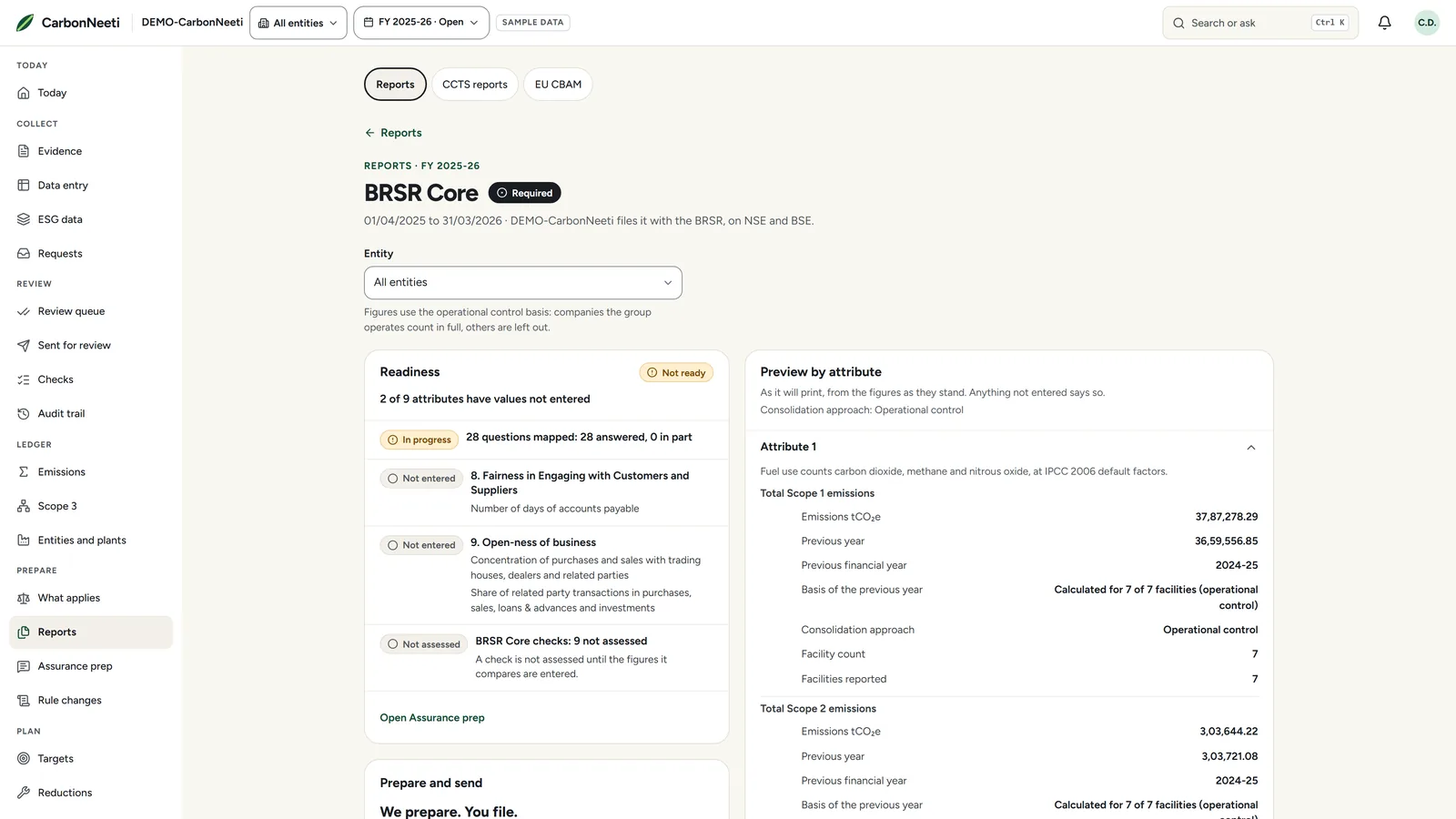
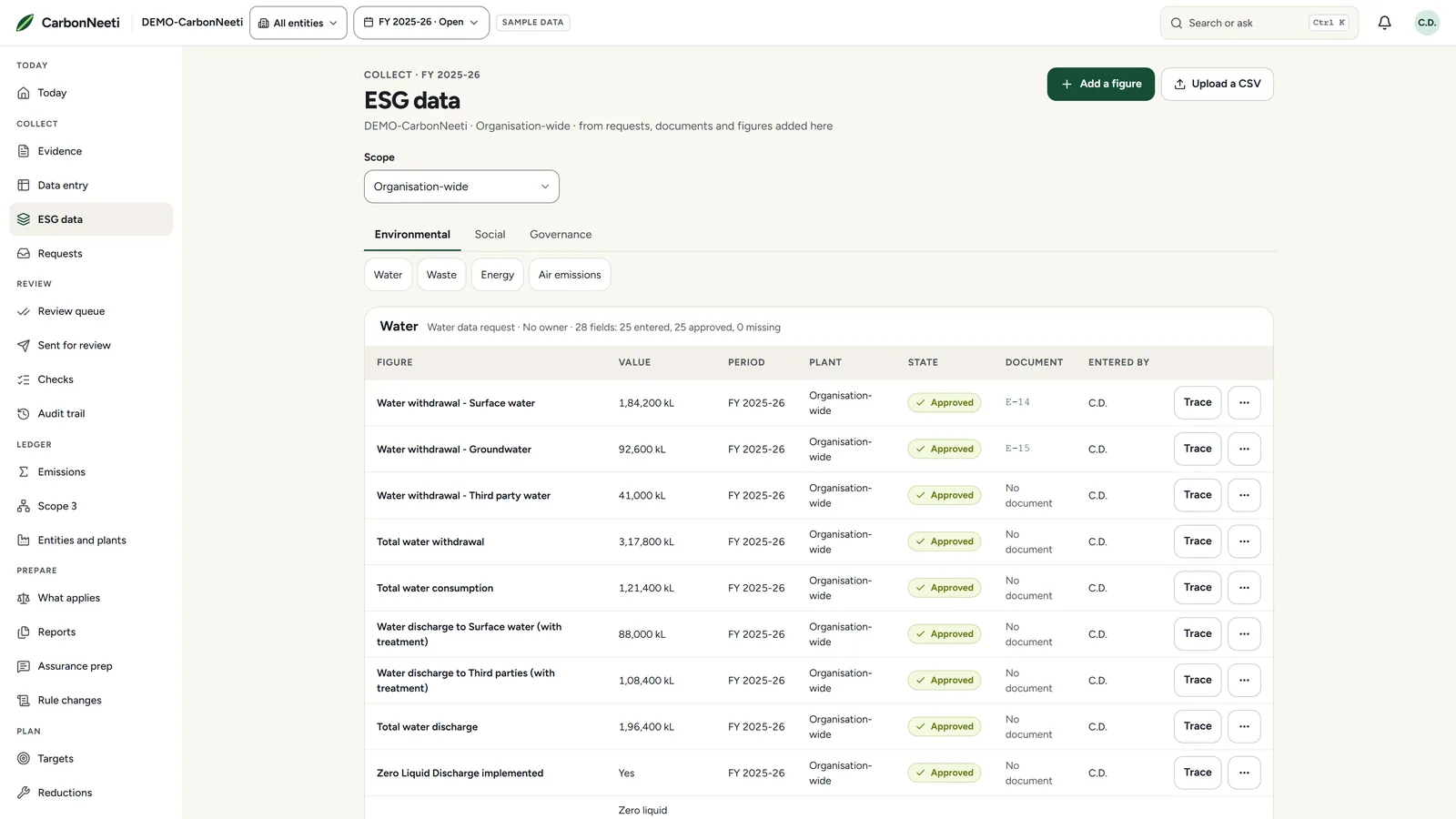
For the GHG attribute, it calculates Scope 1 and Scope 2 emissions per plant with the BEE methodology and sector production units, and shows Scope 2 both location-based and market-based. You can upload bills, invoices and meter records; AI proposes figures with a confidence score, and a person checks, corrects and accepts each one. ESG figures link to the document and page they came from, with an audit log, which gives you the trail to show your provider.
CarbonNeeti does not assess, assure or verify anything; that stays with your assessment or assurance provider. It is free for 30 days with no credit card. See plans or create an account.
Frequently asked questions
What is the difference between assessment and assurance for BRSR Core?
SEBI's March 2025 circular defines assessment as a third-party assessment undertaken as per the standards developed by the Industry Standards Forum in consultation with SEBI. Both routes follow the same glide path and the same rules on provider expertise and conflict of interest. The BRSR asks you to name the provider and the type of assessment or assurance obtained.
Does a company in the top 1000 need BRSR Core assessment or assurance for FY 2026-27?
Yes. The glide path in the current SEBI text extends BRSR Core to the top 1000 listed entities by market capitalisation in FY 2026-27. Listed entities within it must undertake assessment or assurance of the BRSR Core.
Are value chain disclosures under BRSR Core mandatory?
No. Since the March 2025 circular, value chain ESG disclosures apply to the top 250 listed entities on a voluntary basis from FY 2025-26, and their assessment or assurance is voluntary from FY 2026-27. If you disclose, you must state the percentage of sales and purchases covered.
Can our assessment or assurance provider also advise us on BRSR?
No. The listed entity must ensure that the provider and its associates do not sell their products or provide any non-audit, non-assessment or non-assurance service, including consulting, to the entity or its group entities. The Board must also ensure the provider has the necessary expertise.
We prepare. You file. This post is general information, not legal advice; check the cited source before you rely on it.