The BRSR format is the template SEBI prescribes for the Business Responsibility and Sustainability Report that large listed companies publish each year. It has three sections: general disclosures (Section A), management and process disclosures (Section B) and principle-wise performance against the nine principles of the National Guidelines on Responsible Business Conduct (Section C), as laid out in SEBI's updated BRSR format.
Each principle carries essential indicators, which are mandatory, and leadership indicators, which are voluntary, though SEBI asks listed entities to endeavour to report those too (SEBI circular, 10 May 2021). BRSR Core, a subset chosen for assessment or assurance, sits on top.
Below: who must file, what each section asks, and where BRSR Core and value chain disclosures stand today.
Who must file a BRSR
SEBI introduced the BRSR by a circular of 10 May 2021, after amending regulation 34(2)(f) of the LODR Regulations, and it replaced the Business Responsibility Report (BRR) whose format SEBI had prescribed on 4 November 2015. Filing was voluntary for FY 2021-22 and became mandatory from FY 2022-23 for the top 1000 listed companies by market capitalisation.
From FY 2023-24, the top 1000 listed entities report in the updated BRSR format as part of their Annual Reports (SEBI, 12 July 2023). Companies already reporting under GRI, SASB, TCFD or Integrated Reporting may cross-reference those disclosures to the BRSR (SEBI, 10 May 2021).
Section A of the BRSR format: general disclosures
The updated format was issued as Annexure II to the July 2023 circular, after SEBI added the new BRSR Core KPIs to it (SEBI, 12 July 2023). Most of its tables have one column for the current financial year and one for the previous year. Section A has seven parts (BRSR format):
- Entity details: CIN, name, addresses, the financial year reported, stock exchanges, paid-up capital, a contact for queries, the reporting boundary (standalone or consolidated) and the assurance provider.
- Products and services: activities and products accounting for 90% of turnover, with NIC codes.
- Operations: plants and offices in India and abroad, markets served, exports as a percentage of turnover and types of customers.
- Employees: employees and workers by gender and type, differently abled staff, women on the board and in key management, and three years of turnover rates.
- Holding, subsidiary and associate companies, including joint ventures.
- CSR details: whether section 135 of the Companies Act, 2013 applies, with turnover and net worth.
- Transparency and disclosures compliances: complaints by stakeholder group, and material responsible business conduct issues marked as risk or opportunity, with the mitigation approach and financial implications.
Since SEBI's circular of 28 March 2025, items 14 and 15 ask for the name of the assessment or assurance provider and the type of assessment or assurance obtained. The July 2023 template still shows the older assurance-only wording, so update your working copy.
Section B: management and process disclosures
Section B is a grid with one column per principle, P1 to P9 (BRSR format). It covers:
- Policies: whether policies cover each principle and its core elements, board approval, web links, procedures, extension to value chain partners, codes and standards adopted, and commitments and targets with performance against them.
- Governance: a statement by the director responsible for the report, the highest authority responsible for the policies, and whether a board committee or director decides on sustainability issues.
- Review and independent assessment: who reviews performance and statutory compliance and how often, and whether an external agency evaluated the policies.
- Gaps: reasons where a principle has no policy, such as not considering it material or planning it for the next financial year.
Most answers are yes or no, but each yes points to a document someone may ask to see: a board-approved policy, a procedure, a review record.
Section C: the nine principles
Section C takes each NGRBC principle in turn (BRSR format):
| Principle | Businesses should | Essential indicators include |
|---|---|---|
| P1 | conduct and govern themselves with integrity, and in a manner that is ethical, transparent and accountable | fines and penalties, anti-corruption policy, accounts payable days |
| P2 | provide goods and services in a manner that is sustainable and safe | R&D and capex to improve environmental and social impacts, sustainable sourcing, EPR |
| P3 | respect and promote the well-being of all employees, including those in their value chains | well-being measures, retirement benefits, safety incidents |
| P4 | respect the interests of and be responsive to all its stakeholders | key stakeholder groups and how they are engaged |
| P5 | respect and promote human rights | minimum wages, median remuneration, POSH complaints |
| P6 | respect and make efforts to protect and restore the environment | energy, water, air emissions, Scope 1 and 2 GHG, waste |
| P7 | when engaging in influencing public and regulatory policy, do so in a manner that is responsible and transparent | trade association memberships, anti-competitive conduct |
| P8 | promote inclusive growth and equitable development | social impact assessments, sourcing from MSMEs, wages in smaller towns |
| P9 | engage with and provide value to their consumers in a responsible manner | consumer complaints, product recalls, data breaches |
Essential versus leadership indicators
The format says essential indicators are expected from every entity mandated to file the report, while leadership indicators may be disclosed voluntarily by entities that aspire to progress to a higher level (BRSR format). Principle 6 shows the split: Scope 1 and Scope 2 emissions and their intensity are essential; Scope 3 is a leadership indicator. SEBI added an eighth Principle 6 leadership indicator, on green credits generated or procured by the company and by its top ten value chain partners, for BRSR disclosures from FY 2024-25 (SEBI, 28 March 2025).
Principle 6 for manufacturers
The GHG table asks for Scope 1 and Scope 2 in metric tonnes of CO2 equivalent, broken into CO2, CH4, N2O, HFCs, PFCs, SF6 and NF3 if available, with intensity per rupee of turnover, per rupee adjusted for purchasing power parity, and in terms of physical output (BRSR format). Energy, water and waste follow the same pattern, and each table asks whether an external agency assessed or assured it. Our posts on BRSR Principle 6 and CCTS and Scope 1 vs Scope 2 emissions cover the emissions side.
Where BRSR Core sits
BRSR Core is a subset of the BRSR: KPIs under 9 ESG attributes, including some chosen for the Indian context, such as job creation in small towns, openness of business and gross wages paid to women, plus intensity ratios on revenue adjusted for purchasing power parity (SEBI, 28 March 2025). Its approach is a base methodology; any changes or industry-specific adjustments or estimates must be disclosed.
Listed entities must undertake assessment or assurance of BRSR Core on this glide path, by market capitalisation:
- FY 2023-24: top 150 listed entities
- FY 2024-25: top 250
- FY 2025-26: top 500
- FY 2026-27: top 1000
The July 2023 circular first set this glide path as reasonable assurance. Since 28 March 2025 it reads assessment or assurance, where assessment means third-party assessment under standards developed by the Industry Standards Forum (ISF) in consultation with SEBI (SEBI, 28 March 2025). The board must ensure the provider has the necessary expertise, and the provider and its associates must not sell products or provide non-audit, non-assessment or non-assurance services, consulting included, to the company or its group.
Value chain disclosures
The current rule, from the 28 March 2025 circular:
- The value chain is the top upstream and downstream partners each making up 2% or more of purchases and sales by value; disclosure may be limited to 75% of purchases and sales.
- It is voluntary for the top 250 listed entities from FY 2025-26, and assessment or assurance of it is voluntary from FY 2026-27.
- Previous-year figures are voluntary in the first year, and a company that discloses must state the share of sales and purchases its covered partners represent.
As history: the July 2023 circular had used partners cumulatively making up 75% of purchases or sales, on a comply-or-explain basis from FY 2024-25. The 2025 circular deferred it by a year and made it voluntary.
How CarbonNeeti helps you prepare the BRSR
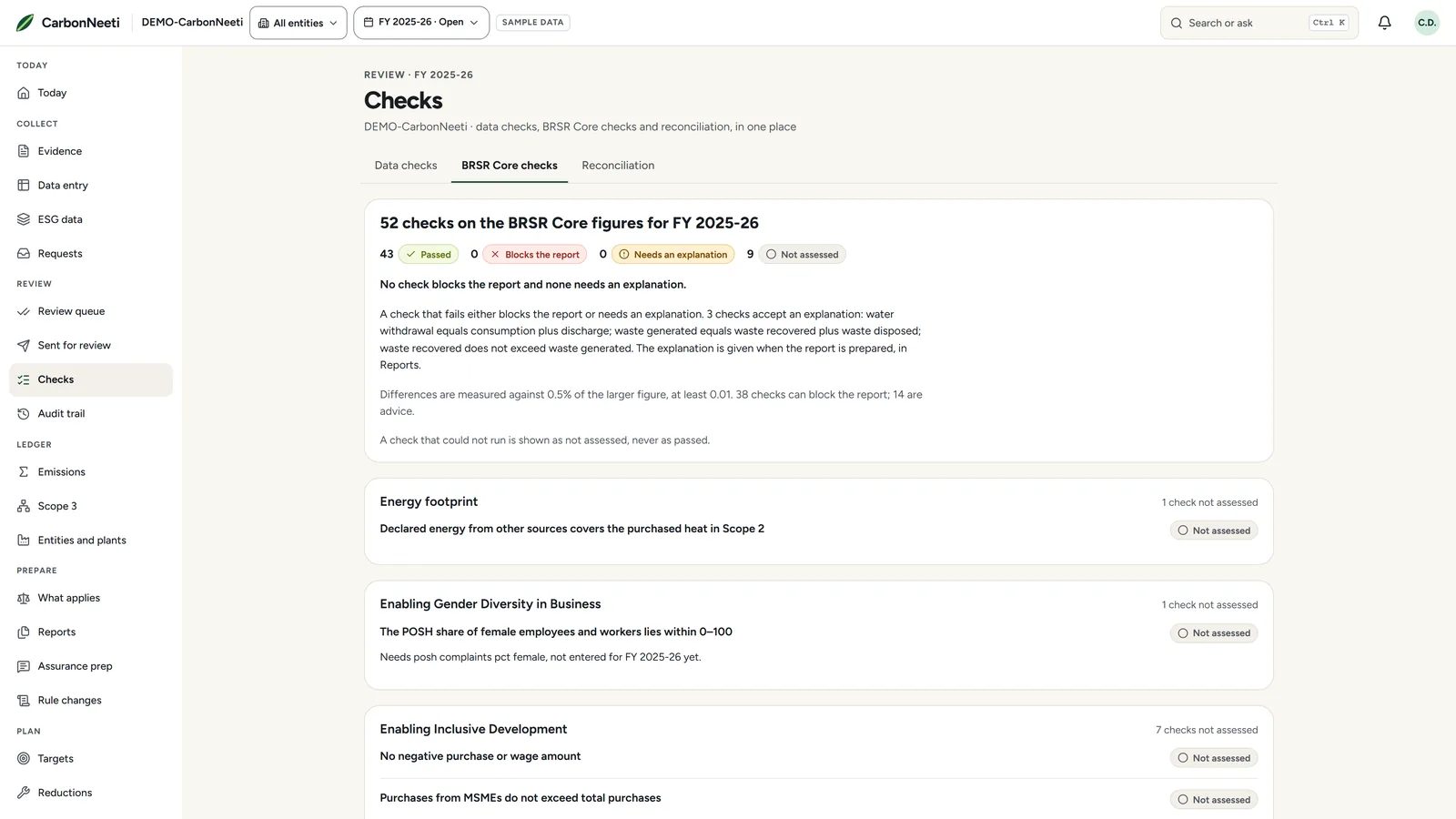
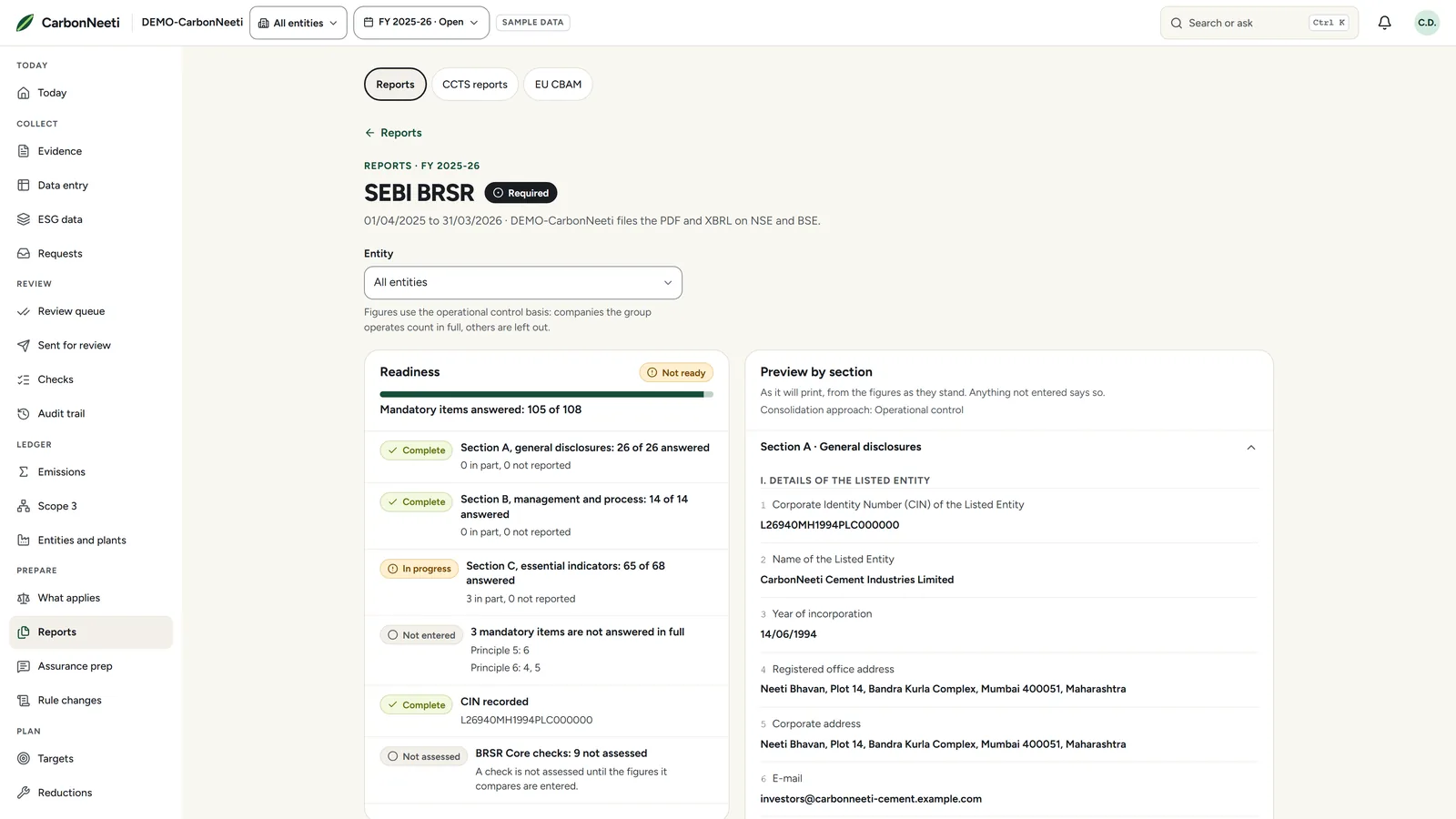
CarbonNeeti prepares SEBI BRSR and BRSR Core disclosures as a PDF, plus a partial XBRL file that you complete in the exchange's BRSR utility before filing. You file the BRSR on NSE and BSE. Verification and assurance stay with your assessment or assurance provider.
- Principle 6 emissions: Scope 1 and Scope 2 per plant, with Scope 2 shown both location-based and market-based, and emission intensity.
- Evidence: upload bills, invoices and meter records; AI proposes figures with a confidence score, and a person checks, corrects and accepts each one. ESG figures link to the document and page they came from, with an audit log.
- Checks: year-on-year change for each plant, and anomaly alerts on the data.
- Deadlines: a compliance calendar with email reminders 7, 3 and 1 days before a deadline.
It is free for 30 days with no credit card. See pricing for plans, or start a trial.
Frequently asked questions
Which companies must file a BRSR?
Filing is mandatory for the top 1000 listed companies by market capitalisation from FY 2022-23; it was voluntary for FY 2021-22 (SEBI, 10 May 2021). From FY 2023-24 they report in the updated format as part of their Annual Reports (SEBI, 12 July 2023).
Are leadership indicators mandatory?
No. Essential indicators are mandatory and leadership indicators are voluntary, although SEBI asks listed entities to endeavour to report them (SEBI, 10 May 2021).
Who needs BRSR Core assessment or assurance for FY 2025-26?
The top 500 listed entities by market capitalisation; the top 1000 come in for FY 2026-27 (SEBI, 28 March 2025). They may choose third-party assessment under ISF standards or assurance.
Are value chain disclosures required for FY 2025-26?
Not mandatorily. For the top 250 listed entities they are voluntary from FY 2025-26, with assessment or assurance voluntary from FY 2026-27 (SEBI, 28 March 2025). A company that discloses must state the share of purchases and sales its covered partners represent.
We prepare. You file. This post is general information, not legal advice; check the cited source before you rely on it.