SEBI changed the rules for BRSR value chain disclosures on 28 March 2025. Its circular SEBI/HO/CFD/CFD-PoD-1/P/CIR/2025/42 dropped the old test of partners making up 75% of purchases or sales, replaced it with a threshold of 2% per partner, and put both the disclosures and their assessment or assurance on a voluntary footing for the top 250 listed entities.
For the compliance officer or consultant preparing a BRSR, that leaves practical questions: which suppliers and customers count, what you ask them for, and how you collect and record what they send.
The circular sets no mandatory date for value chain disclosure or for its assessment or assurance. This post sets out what it does say, and a way to build the process while it is still voluntary.
What changed between the 2023 and 2025 circulars
Value chain disclosures came in with SEBI's circular of 12 July 2023 on BRSR Core. That circular defined the value chain as the top upstream and downstream partners cumulatively comprising 75% of purchases or sales by value. It applied the disclosures to the top 250 listed entities on a comply-or-explain basis from FY 2024-25, with limited assurance on a comply-or-explain basis from FY 2025-26.
On 18 December 2024 SEBI's Board decided to revise those provisions, and the March 2025 circular put the decision into effect. In its words, SEBI decided "to defer the disclosure and assessment or assurance with respect to value chain by one year and to revise the threshold for values chain partners", to give listed entities and their partners time to set up measurement and reporting systems and to avoid an unintended cost on small businesses. The 2023 position is now history; the 2025 position is current.
| Point | July 2023 circular (history) | March 2025 circular (current) |
|---|---|---|
| Which partners | Top upstream and downstream partners cumulatively comprising 75% of purchases / sales by value | Top upstream and downstream partners individually comprising 2% or more of purchases and sales by value; disclosure may be limited to cover 75% |
| Which listed entities | Top 250 by market capitalisation | Top 250 by market capitalisation |
| Disclosure | Comply-or-explain from FY 2024-25 | Voluntary from FY 2025-26 |
| Verification | Limited assurance, comply-or-explain from FY 2025-26 | Assessment or assurance, voluntary from FY 2026-27 |
Which partners count under the BRSR value chain threshold
The current wording, para 3.1 of the master circular as rewritten by the March 2025 circular, says the value chain covers "the top upstream and downstream partners of a listed entity, individually comprising 2% or more of the listed entity's purchases and sales (by value) respectively."
Read plainly:
- Upstream partners are tested against purchases. A supplier is in if your purchases from it are 2% or more of your total purchases by value.
- Downstream partners are tested against sales. A customer is in if your sales to it are 2% or more of your total sales by value.
- The test is per partner ("individually"), not a running total until a coverage figure is reached. That is the main change from 2023.
The 75% limit
The same paragraph adds that "the listed entity may limit disclosure of value chain to cover 75% of its purchases and sales (by value) respectively." This is an option, not a requirement. Where the partners at 2% or more together account for more than 75% of purchases, or of sales, the circular lets you limit the disclosure to partners covering 75% on that side.
Coverage is itself a disclosure
If you report value chain disclosures, the new para 3.6 requires you to "disclose the percentage of total sales and purchases covered by the value chain partners, respectively, for which ESG disclosure are provided." The coverage figure should come from the same ledger workings you used to pick the partners, so keep them.
Previous-year figures in the first year
Under the new para 3.5, previous-year numbers are voluntary in the first year of reporting. SEBI's own example: for value chain disclosures of FY 2025-26, reporting data for FY 2024-25 is voluntary.
What you ask value chain partners to disclose
Value chain disclosures are made "as per BRSR Core, as part of its Annual Report" (SEBI, March 2025). BRSR Core is a subset of the BRSR with KPIs under 9 ESG attributes, including KPIs such as job creation in small towns, openness of business and gross wages paid to women, and intensity ratios based on revenue adjusted for purchasing power parity. Our posts on the BRSR format and BRSR Core and its glide path cover the KPIs themselves.
The July 2023 circular also set out how partner data is reported. The March 2025 circular's changes do not address these points:
- Listed entities report the BRSR Core KPIs for their value chain "to the extent it is attributable to their business with that value chain partner".
- Reporting may be segregated for upstream and downstream partners or given on an aggregate basis.
- The scope of reporting and any assumptions or estimates must be clearly disclosed.
The current text adds two lines that matter once partners send numbers. The BRSR Core approach "is only a base methodology", and "any changes or industry specific adjustments / estimations shall be disclosed" (para 2.2). For waste, the note in the BRSR Core format now reads: "Disclosure may be provided if certificates from vendors have been relied upon for assessment or assurance of KPIs on waste management" (SEBI circular, PDF).
Green credits use a different list
The same circular added an eighth leadership indicator to Principle 6, applicable to BRSR disclosures for FY 2024-25 onwards. It asks how many green credits have been generated or procured by the listed entity and "by the top ten (in terms of value of purchases and sales, respectively) value chain partners." That is a top-ten list by value on each side, not the 2% test, so the partners you ask about green credits may not be the same set as the partners in your value chain disclosure. More on that indicator in our post on BRSR Principle 6.
When assessment or assurance applies
Under the March 2025 circular:
- ESG disclosures for the value chain apply to the top 250 listed entities by market capitalisation, on a voluntary basis from FY 2025-26 (para 3.4.1).
- Assessment or assurance of those disclosures applies on a voluntary basis from FY 2026-27 (para 3.4.2).
The circular offers a choice between the two. "Assessment" means third-party assessment undertaken as per the standards developed by the Industry Standards Forum (ISF) in consultation with SEBI.
Do not mix this up with the company's own BRSR Core. Listed entities must undertake assessment or assurance of their BRSR Core on a glide path: the top 500 for FY 2025-26 and the top 1000 for FY 2026-27. A company can therefore be in the mandatory group for its own BRSR Core while its value chain disclosures stay voluntary.
A practical way to collect BRSR value chain data
Voluntary years are the cheapest time to build the process. A workable sequence:
Build the partner lists from the books
Take the financial year's purchases by vendor and sales by customer, by value, from the same ledgers that support the annual report. Group entities of the same partner the way your finance team already does for related-party and vendor reporting, and write down the rule you used.
Mark the partners and the coverage
Flag every supplier at 2% or more of purchases and every customer at 2% or more of sales. Work out the cumulative share on each side, decide whether to use the 75% limit, and record the percentage covered, since you will disclose it. Separately, mark the top ten partners by purchases and by sales for the green credits indicator.
Send a request built on BRSR Core
Base the request on the BRSR Core format rather than a questionnaire of your own, so the answers drop into the disclosure. Ask for the share attributable to their business with you, or the whole-company figure with the basis they used to arrive at your share.
Ask for the basis, not only the figure
For each KPI, ask whether the figure is measured or estimated, which methodology was used, and what document supports it. For waste KPIs, ask for any certificates you would rely on, since the format allows that to be disclosed.
Keep a log of gaps and estimates
Record which partners responded, which did not, and every assumption or estimate you applied. The July 2023 circular requires the scope of reporting and any assumptions or estimates to be disclosed, and the log is what you will write that disclosure from.
Keep the trail for later
Assessment or assurance of value chain disclosures is voluntary from FY 2026-27. If the company may opt in, file partner responses and your workings so a provider can follow each figure back to its source.
How CarbonNeeti helps
CarbonNeeti prepares SEBI BRSR and BRSR Core disclosures as a PDF, plus a partial XBRL that you complete in the exchange's BRSR utility before filing. You upload documents such as bills, invoices and meter records; AI proposes figures with a confidence score, and a person checks, corrects and accepts each one. ESG figures link to the document and page they came from, with an audit log, and the compliance calendar sends email reminders 7, 3 and 1 days before a deadline.
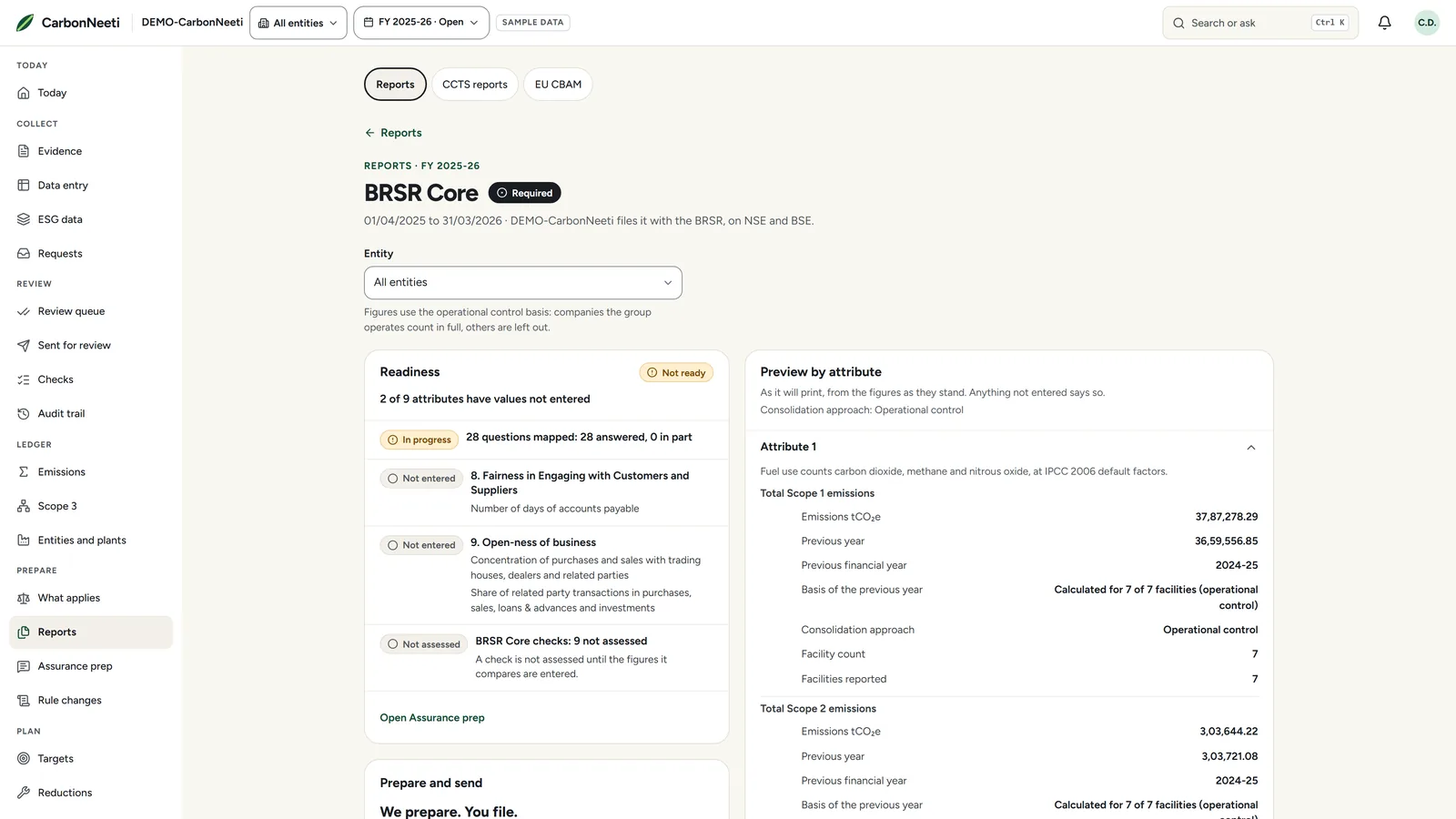
Partner outreach and the coverage decision stay with your team. CarbonNeeti does not verify or assure anything; that stays with your assessment or assurance provider, and you file the BRSR on NSE and BSE. It is free for 30 days with no credit card at sign-up; plans are on the pricing page.
Frequently asked questions
Is BRSR value chain disclosure mandatory for FY 2025-26?
No. Under SEBI's March 2025 circular, ESG disclosures for the value chain apply to the top 250 listed entities by market capitalisation on a voluntary basis from FY 2025-26. The earlier comply-or-explain basis from FY 2024-25, set in July 2023, was replaced.
Does the 2% threshold apply to purchases and sales together?
No. The circular applies it to purchases and sales "respectively": upstream partners individually comprising 2% or more of purchases, and downstream partners individually comprising 2% or more of sales. The entity may limit disclosure to partners covering 75% of purchases and sales respectively.
When does assessment or assurance of value chain disclosures apply?
It applies on a voluntary basis from FY 2026-27. The entity may choose assessment, meaning third-party assessment under standards developed by the Industry Standards Forum in consultation with SEBI, or assurance.
Do we have to report previous-year figures for partners in the first year?
No. For the first year of reporting value chain disclosures, previous-year numbers are voluntary. SEBI's example is that for FY 2025-26 disclosures, FY 2024-25 data is voluntary.
We prepare. You file. This post is general information, not legal advice; check the cited source before you rely on it.