A listed company's Business Responsibility and Sustainability Report (BRSR) ends with a filing on the stock exchanges. This post is about the BRSR XBRL step: what SEBI actually requires, and what is left to the exchange's filing system. In short, SEBI's circulars settle what the BRSR must disclose and who must file it. The SEBI texts we read for this post do not describe the electronic filing itself.
Below we set out what those SEBI documents say about the BRSR and its filing route, where the current text now sits, what they leave unsaid, and how to settle the figures before anyone opens the exchange utility.
Every regulatory point is cited to the SEBI document it comes from. Where a document is older and has since been consolidated, we say so.
Where the BRSR requirement comes from
SEBI introduced the BRSR by its circular of 10 May 2021 (SEBI/HO/CFD/CMD-2/P/CIR/2021/562). It followed an amendment to regulation 34(2)(f) of the LODR Regulations by Gazette notification dated 5 May 2021. It replaced the Business Responsibility Report (BRR), whose format SEBI had prescribed by circular dated 4 November 2015.
The circular put the BRSR format in Annexure I and a guidance note in Annexure II, the latter "to enable the companies to interpret the scope of disclosures". When a disclosure is ambiguous, the guidance note is the first place to look.
On who files, the 2021 circular said that filing of the BRSR would be mandatory for the top 1000 listed companies by market capitalisation from FY 2022-23, and voluntary for FY 2021-22.
The current text: the LODR Master Circular
The 2021 circular is no longer the best place to read the rule. SEBI's Master Circular for compliance with the LODR Regulations was first issued on 11 July 2023, updated on 11 November 2024, and last updated on 30 January 2026 to include the relevant circulars issued up to 30 December 2025. SEBI says changes were made "to reflect the provisions which are currently in force".
Business responsibility and sustainability reporting by listed entities is Section IV-B of the Master Circular, under Chapter IV, Annual Disclosures. The Master Circular also rescinds the circulars listed in its Appendix to the extent they relate to compliance with the LODR Regulations.
The practical rule for a compliance team: treat the 10 May 2021 circular as history, and check Section IV-B of the Master Circular for the current applicability and format before relying on any threshold, including the top 1000 figure above.
| Document | Date | What it settles |
|---|---|---|
| BRSR circular | 10 May 2021 | Introduced the BRSR, its format and guidance note; filing mandatory for the top 1000 listed companies from FY 2022-23 |
| LODR Master Circular | Last updated 30 January 2026 | The consolidated text in force; the BRSR is in Section IV-B |
| BRSR Core FAQs | On the circular of 12 July 2023 | Questions on the assurance requirements introduced as per the BRSR Core |
What the BRSR has to contain
The BRSR asks listed entities to report on their performance against the nine principles of the National Guidelines on Responsible Business Conduct (SEBI, 10 May 2021). Under each principle, reporting is split in two:
- Essential indicators: reported on a mandatory basis.
- Leadership indicators: voluntary, though SEBI says listed entities "should endeavor" to report them too.
SEBI's stated aim is quantitative and standardised disclosure on ESG parameters, so that investors can compare companies, sectors and years. That is worth keeping in mind at filing time: a structured file only helps comparison if each number in it is defined the same way every year.
Companies that already publish sustainability reports under GRI, SASB, TCFD or Integrated Reporting may cross-reference those disclosures to the ones the BRSR asks for.
For a walk through the sections, see BRSR format explained. For the environment principle and how it meets plant-level emissions data, see BRSR Principle 6 and CCTS.
BRSR Core
According to SEBI's FAQs on the BRSR Core, the circular of 12 July 2023 (SEBI/HO/CFD/CFD-SEC-2/P/CIR/2023/122) introduced assurance requirements as per the BRSR Core. Who needs what, and from which year, is covered in our BRSR Core post. For the filing, the practical point is simpler: the BRSR Core figures you submit should be the figures your assurance provider reviewed.
BRSR XBRL: what the sources say about the filing route
What the SEBI texts establish:
- The listed entity files. The 2021 circular speaks of "filing of BRSR" as mandatory for the companies it covers (SEBI, 10 May 2021).
- The exchanges carry the requirement to companies. SEBI advised the stock exchanges to bring the circular to the notice of all listed entities and to disseminate it on their websites (same circular).
- The exchanges run the systems. The Master Circular directs the recognised stock exchanges and depositories to "put in place necessary systems and infrastructure for monitoring and implementation" of the circular, and requires listed entities, exchanges, depositories and other stakeholders to comply to the extent applicable (Master Circular, updated 30 January 2026).
What we cannot confirm from these sources: the 10 May 2021 circular and the BRSR Core FAQs do not mention XBRL, and the opening chapters of the Master Circular that we read do not describe the BRSR filing format. We have not reproduced Section IV-B here. So this post does not name a taxonomy, a filing utility, validation rules or a file format.
If you came here for those details, read Section IV-B of the Master Circular for anything SEBI itself prescribes, and the exchanges' current filing instructions for the mechanics. Read them each year rather than reusing last year's process. We would rather say that plainly than guess at a tag list.
Preparing the figures before you open the exchange utility
Most of the work in a BRSR filing is not the XBRL. It is getting to figures that will not change after they are typed in. A sequence that works:
- Fix the boundary and the year. Decide which entities, plants and offices the report covers and use the same financial year for every figure. Write the decision down; the guidance note in Annexure II is where to check scope questions.
- Tie each figure to its evidence. Water, energy, waste and emissions figures should each point to the bill, meter record or register they came from, down to the page.
- Have a second person review. The person who entered a figure should not be the one who approves it.
- Decide on leadership indicators deliberately. They are voluntary. Record which ones you report and why, so next year's team does not reopen the question.
- Map cross-references once. If you also report under GRI, SASB, TCFD or Integrated Reporting, keep a single mapping from those disclosures to the BRSR rather than rebuilding it at filing time.
- Freeze, then transcribe. Lock the approved figures before anyone starts on the exchange utility. The PDF and the XBRL should carry the same values; if a figure changes after you start, change it at the source and regenerate both.
- Line up with assurance. Where BRSR Core assurance applies, agree with your assurance provider which version of the figures they reviewed, and file that version.
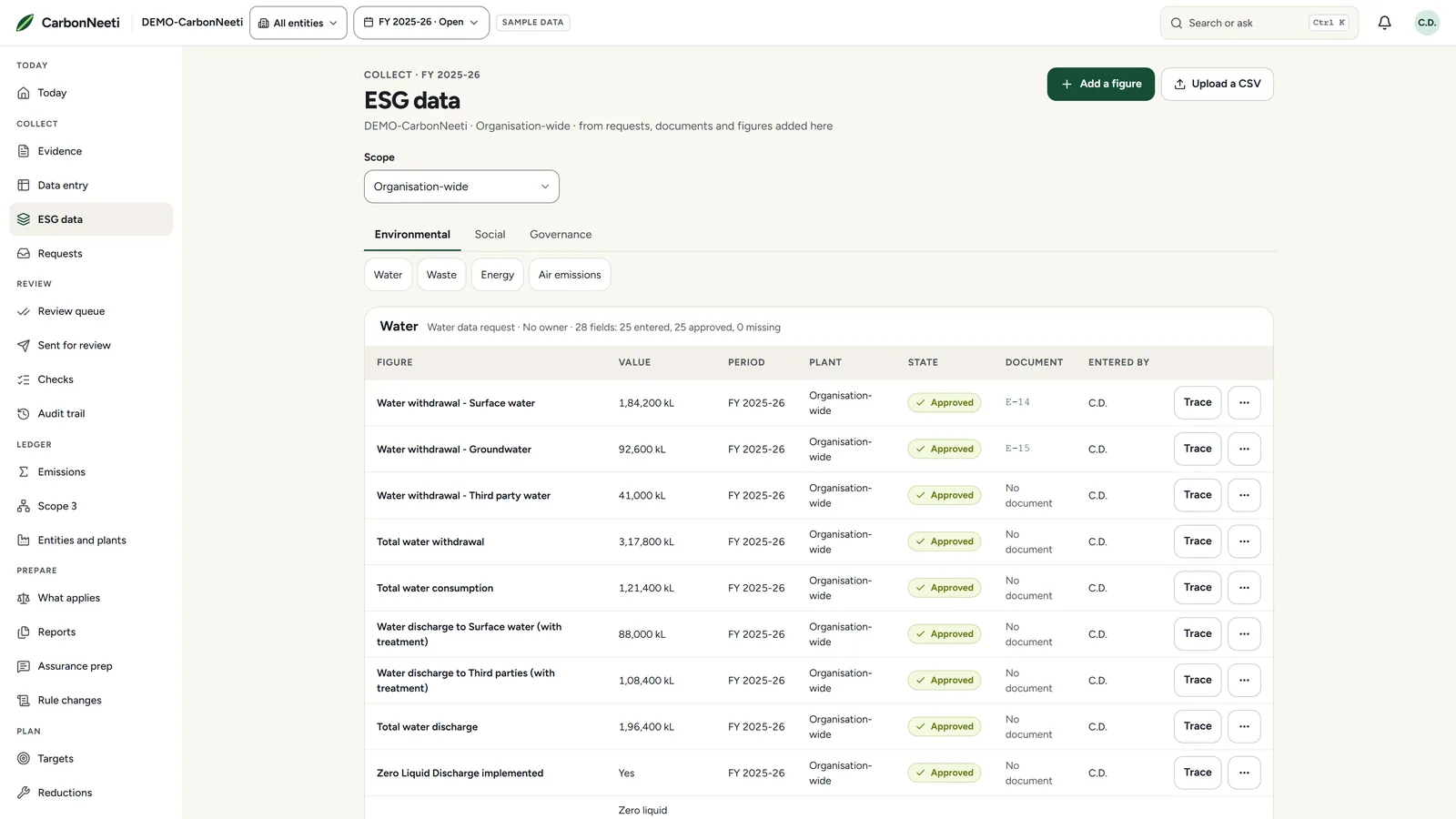
Seen this way, the exchange utility is a transcription step. If the figures are settled, approved and traceable before it starts, the XBRL becomes a matter of entering known values in known places.
How CarbonNeeti helps
CarbonNeeti prepares the SEBI BRSR and BRSR Core disclosures as a PDF, plus a partial XBRL file that your team completes in the exchange's BRSR utility before filing. It does not file anything: you file the BRSR on NSE and BSE. We prepare. You file.
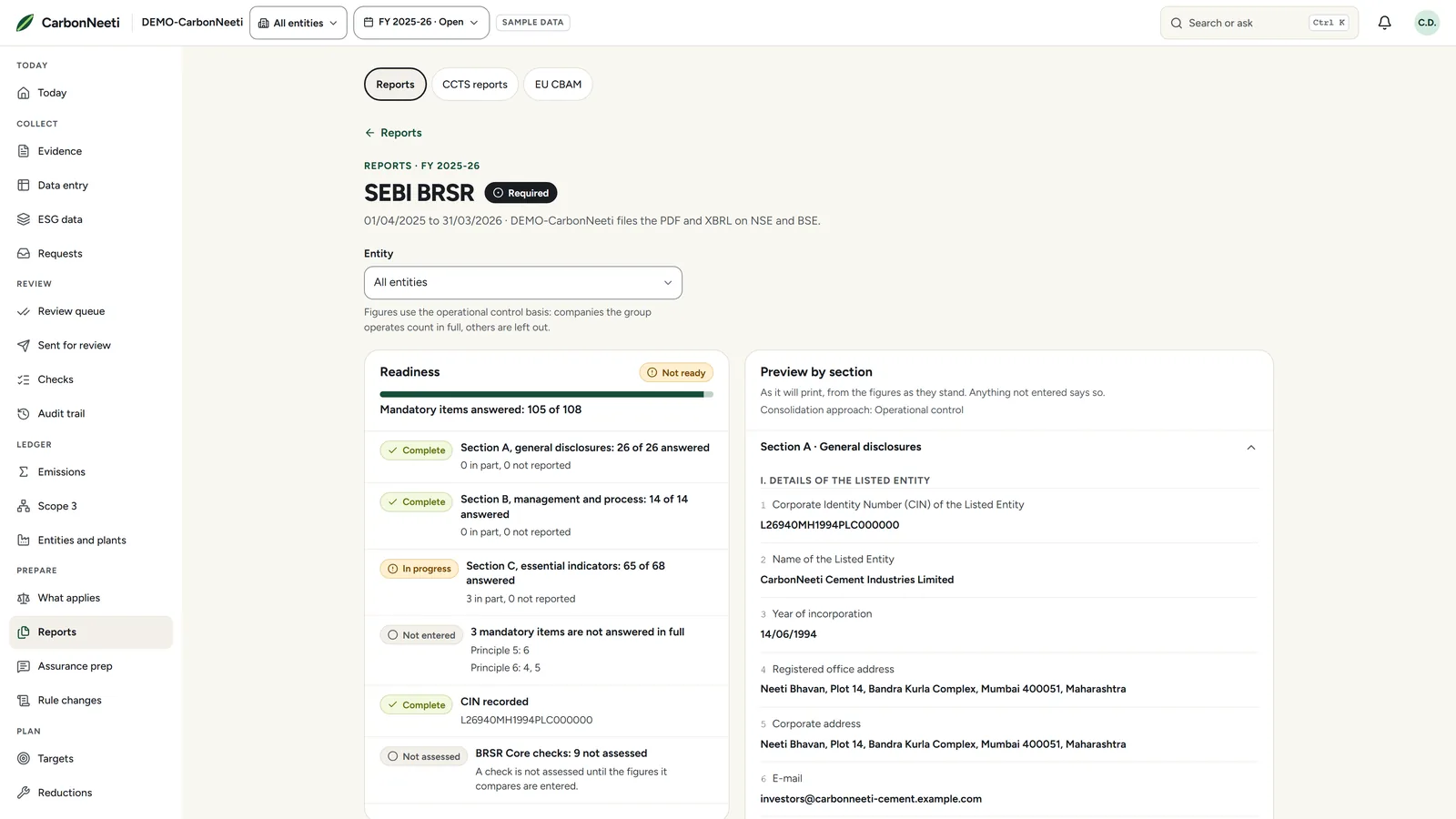
What sits behind those reports:
- ESG figures link to the document and page they came from, with an audit log.
- You upload bills, invoices and meter records; AI proposes figures with a confidence score, and a person checks, corrects and accepts each one.
- Scope 1 and Scope 2 emissions are calculated per plant with the BEE methodology, and Scope 2 is shown both location-based and market-based.
- Year-on-year change for each plant, and anomaly alerts on the data.
- A compliance calendar sends email reminders 7, 3 and 1 days before a deadline.
Verification and assurance stay with your assurance provider; CarbonNeeti does not verify, assure or certify. It is free for 30 days with no credit card. Plans are on the pricing page, and you can register to start.
Frequently asked questions
Does SEBI's BRSR circular say the report must be filed in XBRL?
The 10 May 2021 circular makes filing of the BRSR mandatory for the companies it covers and replaces the BRR, but its text does not mention XBRL. Neither do SEBI's BRSR Core FAQs. Check Section IV-B of the Master Circular and the exchanges' current filing instructions for the form of submission.
Are all BRSR indicators mandatory?
No. Under each of the nine principles, essential indicators are reported on a mandatory basis and leadership indicators are voluntary (SEBI, 10 May 2021). SEBI says listed entities should endeavour to report the leadership indicators as well.
Which companies have to file a BRSR?
The 2021 circular made filing mandatory for the top 1000 listed companies by market capitalisation from FY 2022-23, and voluntary for FY 2021-22. The current position is consolidated in Section IV-B of the LODR Master Circular, last updated on 30 January 2026, so check applicability there.
Can we reuse our GRI or TCFD sustainability report?
Partly. SEBI allows listed entities that already report under GRI, SASB, TCFD or Integrated Reporting to cross-reference those disclosures to the ones the BRSR asks for (SEBI, 10 May 2021). The BRSR itself still has to be prepared in SEBI's format.
We prepare. You file. This post is general information, not legal advice; check the cited source before you rely on it.